sweet things
Chocolate as a Gift in a Hot Country
What happens to chocolate in a South African summer, what survives the trip, and how to make a sweet gift read as thought rather than habit.
Straight to the gifts: Shop cakes Shop hampers Valentine's gifts Thank you gifts Birthday gifts
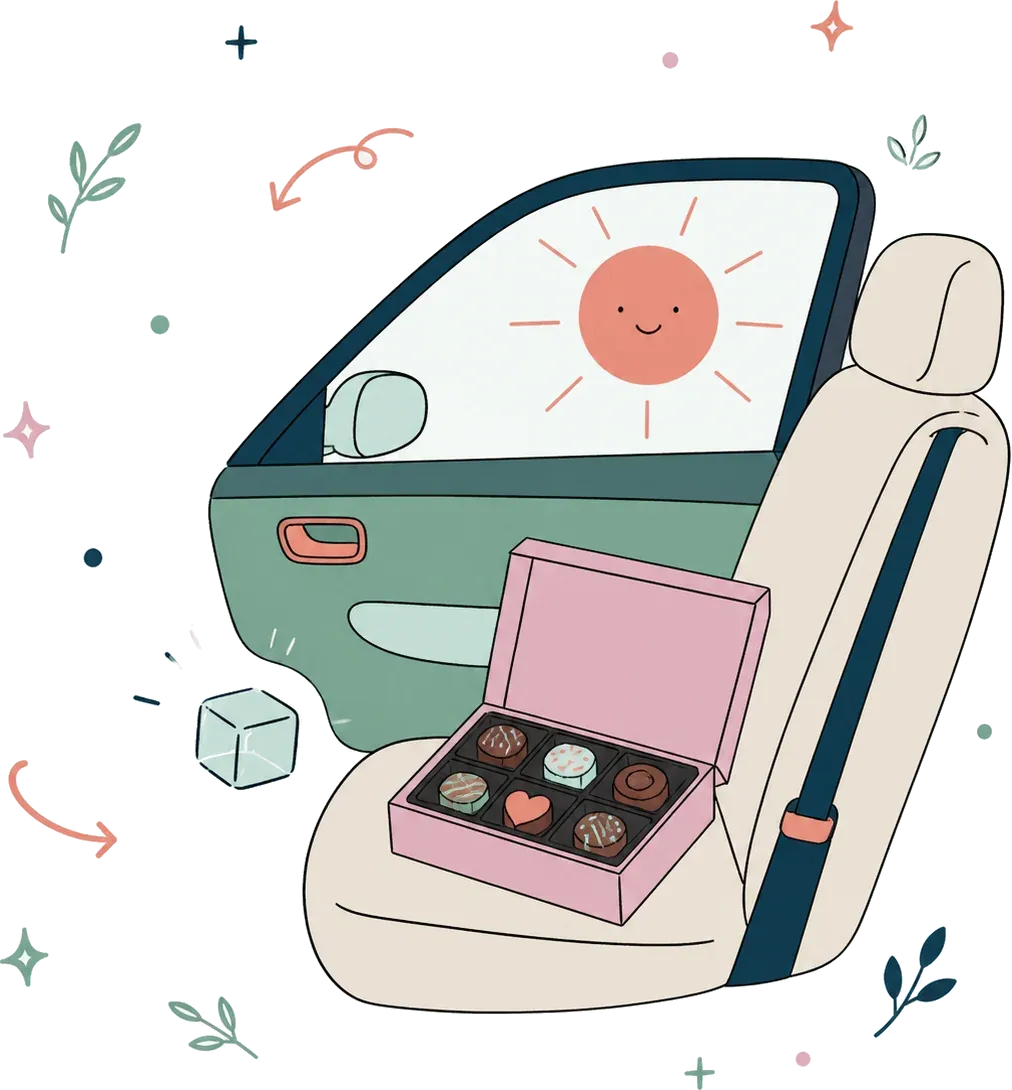
The boot of the car is where chocolate gifts die
Chocolate melts at roughly the temperature of a warm room, which is the whole problem with giving it in South Africa. A car parked in the sun in Gauteng in January goes far past that within minutes, and a chocolate gift left in the boot between the shop and the party arrives as a bag of soft shapes. Even chocolate that resets in the fridge is spoiled: melted and re-hardened chocolate turns grey and streaky on the surface, still safe to eat, no longer a gift.
So the first rule of chocolate gifting here is logistics, not selection. Chocolate is the last thing into the car and the first thing out, it rides in the aircon with you and never in the boot, and it does not sit in a parked car while you run one more errand. If it is being delivered, the same heat applies in the courier van and at the gate: in high summer, a delivery that will stand outside for hours is a delivery you should not book, and what any shop promises about how its chocolate travels is set out in its own terms, not anyone else’s.
What survives the heat and what does not
Not all sweet things are equally doomed. The delicate end is filled chocolate: truffles, pralines, anything with a soft centre. These soften first, lose their shine and their shape, and are the worst choice for a hot trip. Moulded and hollow shapes go next. White and milk chocolate are softer than dark to begin with, and dark chocolate holds out somewhat longer, but the honest answer is that in real summer heat, all of it melts; dark just melts last.
The hardy end is everything that is not really chocolate. Fudge, nougat, brittle and Turkish delight tolerate warmth. Hard-boiled sweets barely notice it. Biscuits, rusks and baked things shrug it off entirely. Chocolate-coated nuts and raisins survive better than bars because a little surface softening does not ruin them. In the hottest months, the smart sweet gift moves down this list: a beautiful box of nougat in January beats a beautiful box of truffles that arrives as one truffle.
Season flips the logic. From roughly May to August, in most of the country, chocolate travels fine and the whole shop is open to you. If the gift can wait for a winter birthday rather than a December one, the chocolate options double.
A chocolate gift is not a chocolate add-on
The same slab plays two completely different roles depending on billing. As an add-on, chocolate is a supporting act: a small box riding along with flowers or a hamper, there to add a second texture to the gesture. Nobody judges an add-on hard, and a modest, decent chocolate does that job perfectly.
As the gift itself, chocolate has to carry the whole message alone, and the bar rises accordingly. A gift-grade chocolate purchase shows selection: a specific style the person loves, a maker or an origin chosen on purpose, a box that was clearly picked rather than grabbed. The quantity matters less than the evidence of choice. One superb slab chosen for a known taste outranks a big anonymous assortment every time.
Thoughtful chocolate versus forecourt chocolate
Everyone knows the difference on sight, even if nobody says it. A familiar supermarket slab handed over on its own says “I remembered at the last petrol stop”. The same rand value spent on something the person specifically loves, the exact mint ones, the sea-salt dark they always mention, says “I know you”. The line between thoughtful and lazy chocolate is not price, it is specificity.
Three cheap ways to move a chocolate gift up the scale. Match it to a known taste, which turns any chocolate into proof of attention. Pair it: chocolate plus good coffee, chocolate plus a book, chocolate plus the card that does the real talking. And present it: the same contents in a proper box with a written card reads as a decision, not a reflex.
One more honest note: because chocolate is the world’s default small gift, the recipient may be drowning in it, especially around Christmas and after a hospital stay. If you suspect the person has a drawer full already, that is the moment to send fruit, biscuits, coffee or flowers instead.
When the person does not eat sugar
More people than ever are off sugar, by medical need, by diet or by choice, and a chocolate gift to someone who cannot eat it is worse than no gift: it makes them perform gratitude for a thing that excludes them. If there is any doubt, find out before you buy, or choose outside the sugar aisle altogether.
If sweetness is still the brief, there are honest routes. No-added-sugar and diabetic-friendly ranges exist and have improved, but read labels rather than trusting a shelf category, and know that “sugar-free” does not mean “eat freely” for a diabetic, so for medical cases let the person’s own rules lead. Very dark chocolate carries far less sugar than milk and is many low-sugar eaters’ one exception, but it is their exception to make, not yours to assume.
Often the better move is sideways: excellent nuts, biltong, cheese and crackers, good coffee or tea, olives, a savoury hamper. The point of a chocolate gift was never actually the chocolate. It was a small luxury the person would not buy themselves, and every one of those alternatives does the same job without the sugar, and without melting in the boot either.
Ready to turn the thought into a gift?